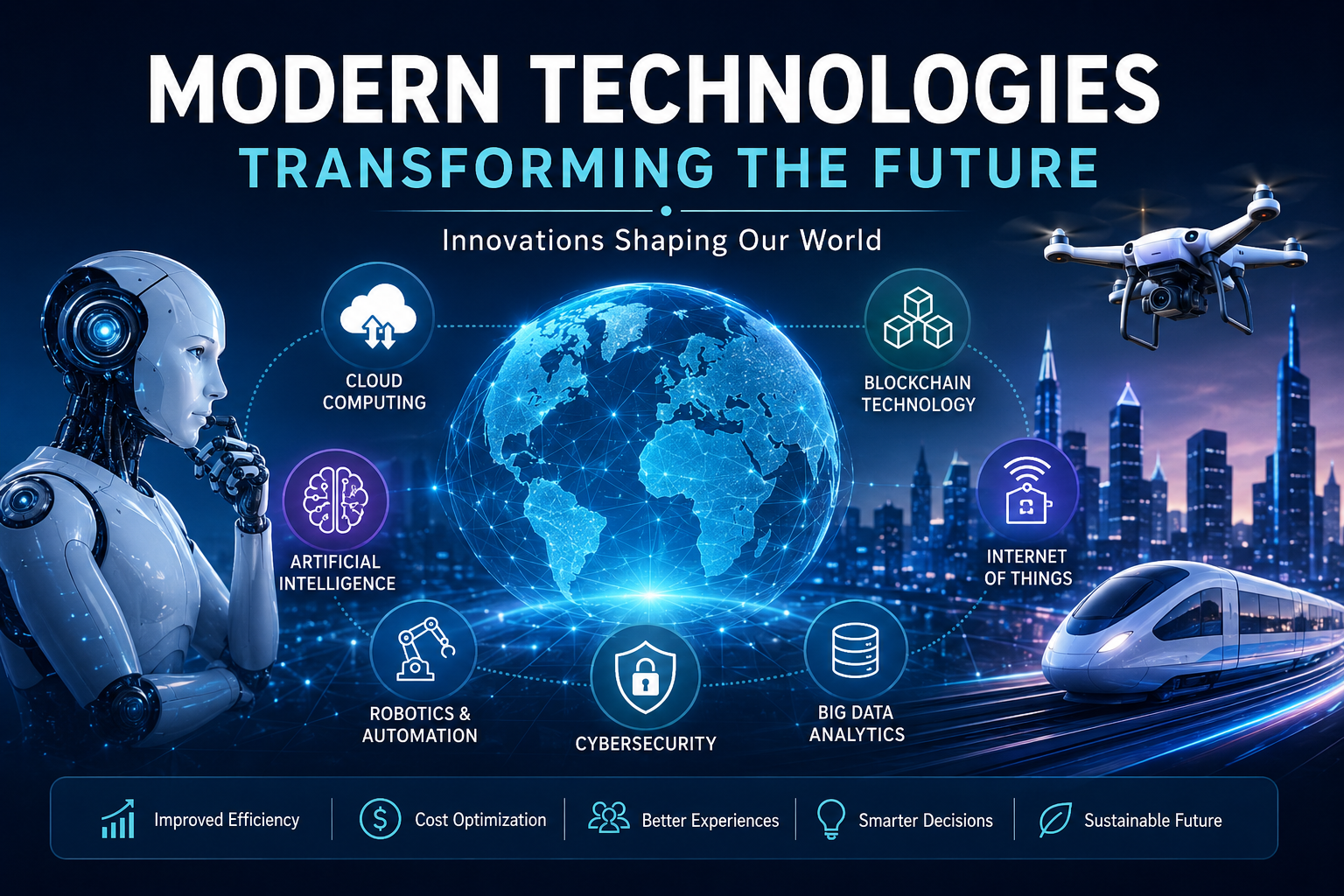
Businesses are embracing digital transformation to improve productivity, reduce costs, and deliver better customer experiences. Individuals are benefiting from smarter devices, faster internet, personalized services, and innovative healthcare solutions. As technology continues to evolve, staying informed about the latest developments is essential for professionals, entrepreneurs, students, and organizations alike.
This guide explores the most important modern technologies that are changing the world, their real-world applications, benefits, challenges, and the future trends that will continue to shape our digital lives.
What Are Modern Technologies?
Modern technologies refer to innovative digital tools, systems, and scientific advancements that improve efficiency, communication, automation, security, and problem-solving across industries. These technologies leverage computing power, connectivity, artificial intelligence, and data to deliver smarter solutions.
Modern technologies impact nearly every sector, including:
- Healthcare
- Finance
- Education
- Manufacturing
- Agriculture
- Retail
- Transportation
- Entertainment
- Government
- Telecommunications
Organizations that adopt emerging technologies gain a competitive advantage by increasing operational efficiency, reducing costs, improving customer satisfaction, and accelerating innovation.
1. Artificial Intelligence (AI)
Artificial Intelligence (AI) enables computers and machines to perform tasks that traditionally require human intelligence. AI systems can analyze data, recognize speech, understand language, generate content, automate repetitive processes, and make intelligent decisions.
Today, AI is integrated into countless applications, from virtual assistants and recommendation engines to fraud detection systems and autonomous vehicles.
Common Applications
- AI chatbots
- Virtual assistants
- Content generation
- Customer service automation
- Predictive analytics
- Medical diagnosis
- Image recognition
- Language translation
- Fraud detection
- Software development
Benefits
- Faster decision-making
- Increased productivity
- Reduced operational costs
- Personalized customer experiences
- Improved business insights
2. Machine Learning
Machine Learning is a branch of artificial intelligence that enables systems to learn from historical data and improve performance over time without explicit programming.
Machine learning algorithms identify hidden patterns, make predictions, and continuously improve their accuracy.
Real-World Examples
- Netflix recommendations
- Spam email filtering
- Credit scoring
- Stock market analysis
- Product recommendations
- Voice assistants
- Predictive maintenance
Machine learning continues to revolutionize industries through intelligent automation and data-driven decision-making.
3. Generative AI
Generative AI is transforming creativity by producing high-quality text, images, videos, music, presentations, and software code.
Businesses now use generative AI for:
- Marketing campaigns
- Blog writing
- Graphic design
- Customer support
- Programming
- Education
- Video creation
- Product descriptions
Generative AI significantly reduces content creation time while improving productivity.
4. Cloud Computing
Cloud computing delivers computing resources such as servers, storage, databases, networking, and software over the internet.
Instead of purchasing expensive hardware, organizations pay only for the resources they use.
Advantages
- Scalability
- High availability
- Automatic backups
- Lower infrastructure costs
- Remote accessibility
- Improved collaboration
Cloud computing has become the backbone of modern digital businesses.
5. Edge Computing
Edge computing processes data closer to where it is generated rather than sending all information to centralized cloud servers.
This reduces latency and improves real-time decision-making.
Common Applications
- Smart factories
- Healthcare devices
- Connected vehicles
- Smart cities
- Retail automation
- Industrial IoT
Edge computing complements cloud computing by enabling faster local processing.
6. Internet of Things (IoT)
The Internet of Things (IoT) connects physical devices through the internet, allowing them to communicate and exchange information automatically.
Examples include:
- Smart home devices
- Smart watches
- Connected vehicles
- Industrial sensors
- Agricultural monitoring systems
- Smart energy meters
IoT improves automation, efficiency, and real-time monitoring.
7. Blockchain Technology
Blockchain is a decentralized digital ledger that securely records transactions across multiple computers.
Beyond cryptocurrency, blockchain supports:
- Digital identity
- Supply chain management
- Smart contracts
- Healthcare records
- Secure payments
- Voting systems
- Intellectual property protection
Blockchain enhances transparency and reduces fraud.
8. Cybersecurity
As digital transformation accelerates, protecting data and systems has become increasingly important.
Modern cybersecurity technologies include:
- Zero Trust Architecture
- Multi-Factor Authentication (MFA)
- AI-powered threat detection
- Endpoint security
- Identity management
- Cloud security
- Data encryption
Cybersecurity safeguards organizations from ransomware, phishing attacks, malware, and data breaches.
9. Big Data Analytics
Every day, businesses generate enormous amounts of data.
Big Data technologies help organizations collect, process, analyze, and visualize this information to make informed decisions.
Applications include:
- Customer behavior analysis
- Healthcare research
- Financial forecasting
- Marketing optimization
- Fraud detection
- Predictive maintenance
Data-driven organizations consistently outperform competitors.
10. Robotics and Intelligent Automation
Modern robots are becoming smarter through artificial intelligence and machine learning.
Industries benefiting from robotics include:
- Manufacturing
- Warehousing
- Logistics
- Agriculture
- Healthcare
- Hospitality
Automation reduces repetitive work while increasing productivity and accuracy.
11. Quantum Computing
Quantum computing represents the next generation of computing power.
Unlike traditional computers that use binary bits, quantum computers use quantum bits (qubits), enabling them to solve complex problems exponentially faster.
Potential applications include:
- Drug discovery
- Climate simulation
- Financial optimization
- Logistics
- Cryptography
- Scientific research
Although still developing, quantum computing is expected to revolutionize multiple industries.
12. Augmented Reality (AR)
Augmented Reality overlays digital content onto the real world using smartphones, tablets, or smart glasses.
Popular applications include:
- Product visualization
- Navigation
- Interactive learning
- Gaming
- Industrial maintenance
- Retail shopping
AR improves user engagement and customer experiences.
13. Virtual Reality (VR)
Virtual Reality creates immersive digital environments using specialized headsets.
Industries using VR include:
- Gaming
- Healthcare
- Military training
- Education
- Architecture
- Tourism
- Engineering
VR allows users to experience realistic simulations without physical limitations.
14. Extended Reality (XR)
Extended Reality combines Virtual Reality, Augmented Reality, and Mixed Reality into immersive digital experiences.
XR is being adopted for:
- Corporate training
- Remote collaboration
- Product demonstrations
- Healthcare
- Engineering
- Entertainment
15. 5G Connectivity
Fifth-generation wireless technology delivers:
- Faster internet speeds
- Lower latency
- Improved network reliability
- Massive device connectivity
5G enables:
- Smart cities
- Autonomous vehicles
- Industrial automation
- Telemedicine
- IoT expansion
16. Digital Twins
A digital twin is a virtual representation of a physical object or system.
Organizations use digital twins to:
- Monitor equipment
- Predict failures
- Optimize manufacturing
- Improve infrastructure management
- Reduce maintenance costs
Digital twins improve operational efficiency through real-time simulations.
17. Sustainable Technology
Technology plays a vital role in environmental sustainability.
Examples include:
- Renewable energy systems
- Smart power grids
- Electric vehicles
- Carbon monitoring
- Energy-efficient data centers
- Green manufacturing
Sustainable technologies help reduce environmental impact while supporting long-term economic growth.
18. Low-Code and No-Code Platforms
Businesses increasingly use low-code and no-code platforms to build applications with minimal programming knowledge.
Benefits include:
- Faster development
- Lower costs
- Improved collaboration
- Rapid deployment
- Increased business agility
These platforms accelerate digital transformation initiatives.
19. Autonomous Vehicles
Self-driving technology combines AI, sensors, cameras, GPS, and machine learning to navigate roads with minimal human intervention.
Potential benefits include:
- Improved road safety
- Reduced traffic congestion
- Lower transportation costs
- Enhanced mobility
Autonomous vehicles continue to evolve through extensive testing and innovation.
20. Smart Cities
Smart cities use connected technologies to improve urban living.
Examples include:
- Intelligent traffic systems
- Smart street lighting
- Waste management
- Public safety
- Environmental monitoring
- Smart parking
- Digital governance
These technologies improve quality of life while optimizing city resources.
Benefits of Modern Technologies
Modern technologies provide significant advantages across industries:
- Improved productivity
- Better customer experiences
- Enhanced communication
- Lower operational costs
- Increased automation
- Better security
- Faster innovation
- Data-driven decision-making
- Global collaboration
- Sustainable development
Challenges of Modern Technologies
Despite their advantages, modern technologies also present challenges.
Common issues include:
- Cybersecurity threats
- Data privacy concerns
- High implementation costs
- Skill shortages
- Ethical AI considerations
- Digital divide
- Regulatory compliance
- Technology dependence
Organizations should adopt technologies responsibly while investing in governance, security, and workforce development.
Industries Being Transformed
Modern technologies are reshaping nearly every sector, including:
- Healthcare
- Banking and Finance
- Retail and E-commerce
- Education
- Manufacturing
- Transportation
- Agriculture
- Government
- Telecommunications
- Entertainment
- Logistics
- Real Estate
Every industry now relies on digital innovation to remain competitive.
The Future of Technology
The future will see even greater integration of intelligent systems into daily life.
Emerging trends include:
- AI-powered digital assistants
- Autonomous AI agents
- Human-AI collaboration
- Personalized healthcare
- Intelligent robotics
- Spatial computing
- Brain-computer interfaces
- Privacy-enhancing technologies
- Green computing
- Advanced automation
As these technologies mature, they will redefine how people live and work.
How Businesses Can Prepare
Organizations should focus on:
- Investing in digital transformation
- Strengthening cybersecurity
- Upskilling employees
- Leveraging cloud infrastructure
- Implementing AI responsibly
- Building data-driven cultures
- Encouraging innovation
- Modernizing legacy systems
Businesses that embrace innovation are better positioned for sustainable growth and long-term success.
Conclusion
Modern technologies are no longer optional—they are fundamental to success in today's digital world. Artificial intelligence, cloud computing, blockchain, cybersecurity, IoT, robotics, quantum computing, and immersive technologies are transforming industries, improving lives, and creating new opportunities for innovation.
Whether you are a business owner, software developer, student, or technology enthusiast, understanding these technologies will help you stay ahead in an increasingly competitive landscape. By embracing continuous learning and adopting the right digital solutions, individuals and organizations can unlock greater efficiency, resilience, and growth in the years ahead.
Frequently Asked Questions (FAQs)
What are modern technologies?
Modern technologies are advanced digital innovations such as Artificial Intelligence, Cloud Computing, Blockchain, IoT, Robotics, and Cybersecurity that improve efficiency, automation, and connectivity across industries.
Why are modern technologies important?
They help businesses reduce costs, improve productivity, enhance customer experiences, strengthen security, and drive innovation.
Which modern technology has the biggest impact?
Artificial Intelligence is currently one of the most transformative technologies because it powers automation, data analysis, content generation, customer service, and intelligent decision-making.
How do modern technologies benefit businesses?
Businesses benefit through improved efficiency, lower operational costs, better analytics, stronger cybersecurity, enhanced collaboration, and faster product development.
What is the future of modern technologies?
Future developments include autonomous AI agents, quantum computing, advanced robotics, smart cities, personalized healthcare, sustainable technologies, and immersive digital experiences.
SEO Information
SEO Title: Modern Technologies Transforming the Future | Complete Guide
Meta Description: Explore the latest modern technologies transforming businesses and everyday life. Learn about Artificial Intelligence, Cloud Computing, IoT, Blockchain, Robotics, Cybersecurity, Quantum Computing, and more.
Focus Keyword: Modern Technologies
Related Keywords:
- Emerging Technologies
- Latest Technology
- Artificial Intelligence
- Cloud Computing
- Internet of Things
- Blockchain Technology
- Cybersecurity
- Robotics
- Quantum Computing
- Digital Transformation


0 Comments